
Memory Politics, Historical Recognition, and the Institutionalisation of Eelam Tamil Genocide Remembrance


This is not merely a commemorative stone, nor an emotionally charged banner of mourning; rather, it must be understood as part of a wider global architecture of political memory.
When memorial banners, monuments, and documented remembrance sites relating to the genocide of Eelam Tamils are established in various countries with the cooperation of local authorities, municipalities, and councils, they move beyond the realm of private grief and enter the domain of officially recorded civic memory. That transformation is profoundly significant. The moment the suffering of a people is formally inscribed within the archival memory of a municipal or regional governing institution, it ceases to exist solely as “social memory” and begins to acquire the status of a politically acknowledged historical record.

To date, such processes have already emerged in countries including Canada at provincial levels, as well as within municipal frameworks in France and Australia. These developments illustrate how memory politics gradually becomes institutionalised through democratic and administrative structures.
As this form of memory politics continues to expand internationally, the administrative institutions of diaspora states, universities, human rights documentation centres, and eventually even foreign-policy establishments may be compelled to recognise the genocide of Eelam Tamils as a documented and politically undeniable historical reality. In world politics, the international recognition accorded to the Armenian Genocide, the Holocaust, and the Rwandan Genocide did not emerge solely through immediate diplomatic action; rather, such recognition evolved through decades of memorialisation, archival preservation, academic engagement, and public institutional remembrance. In a similar manner, documented memorial spaces relating to the Eelam Tamil genocide may, over time, influence future diplomatic discourse and international policy considerations.
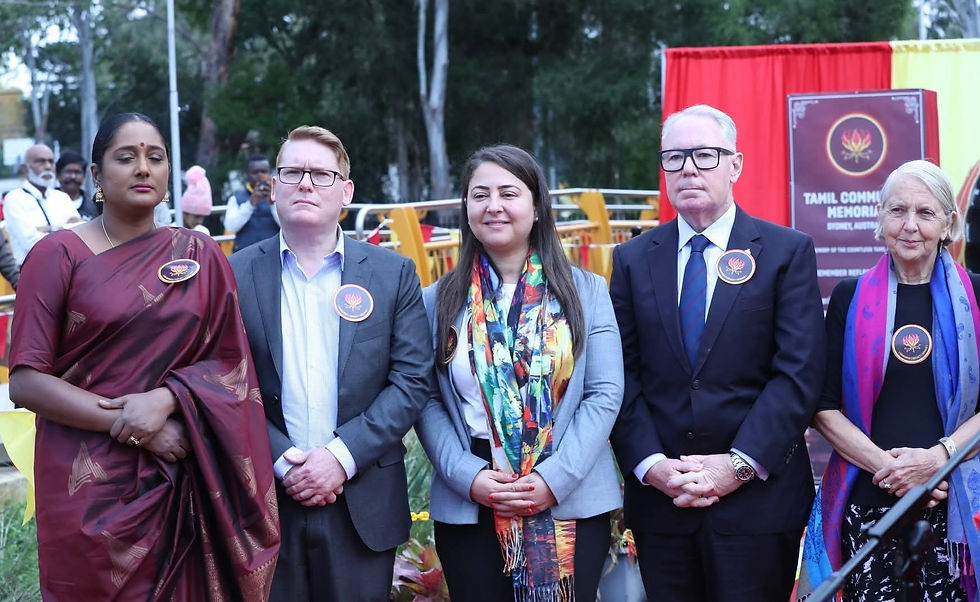
For this reason, these initiatives cannot be dismissed as ordinary symbolic events. Beyond individual preferences, ideological divisions, intimidation, economic pressures, and social constraints, many Eelam Tamils living in the diaspora have attempted — within their limited capacities — to advance forms of memorial politics. Historical justice requires that these efforts be acknowledged. The cumulative effect of numerous small acts of remembrance often becomes the foundation upon which future generations construct enduring political memory.
Likewise, within Tamil Nadu and across India, memorial initiatives relating to the genocide of Eelam Tamils must evolve beyond emotionally symbolic spaces and instead develop into structured historical documentation centres. Such institutions should not merely commemorate the Eelam Tamils who were killed, but also preserve the political sacrifices of those in Tamil Nadu who self-immolated or dedicated their lives in solidarity with the Tamil cause.
A memorial of this nature should not be conceived simply as a statue or commemorative stone. Rather, it ought to function simultaneously as:
1. An archival repository,
2. A political memory institution,
3. A genocide education centre,
4. A documentary resource for future scholars and researchers, and
5. A historical treasury for Tamils across the world.
For societies that fail to document their memories eventually risk hearing their own history narrated through the language, frameworks, and political interests of others.
Furthermore, the expansion of Eelam Tamil genocide memory politics beyond the territorial boundaries of Tamil Nadu into other Indian states must be understood as a long-term political and archival strategy. This is not merely an emotional project of solidarity; rather, it constitutes an effort to reposition the Eelam Tamil question within the federal political structure of India — transforming it from a supposedly “regional issue” into a broader question of human rights, historical memory, federalism, refugee politics, and Indian Ocean geopolitics.
Such a process may unfold through multiple institutional layers, including:
- Establishing collaborations with universities, human-rights organisations, legal research centres, and social-justice movements across various Indian states;
- Organising exhibitions, archival releases, memorial conferences, academic symposiums, and educational forums relating to the genocide of Eelam Tamils;
- Bringing the discourse into formal academic frameworks through concepts such as genocide studies, military occupation, structural violence, memory politics, and maritime geopolitics;
- Introducing these discussions within North Indian intellectual and policy spaces through the lenses of refugee studies, federal governance, security studies, human rights discourse, and Indian Ocean strategic affairs.
Within this broader context, the genocide documentation handbook reportedly presented in 2024 by Indian strategic and academic intellectual circles to the Central Government of India may emerge as a significant political and archival foundation. No struggle for political memory can survive on emotion alone; enduring influence is secured through documentation, evidence, statistical records, legal frameworks, institutional archives, and scholarly engagement.
Such a handbook possesses the potential to evolve into:
- A foundational documentary source for future memorial institutions;
- A core reference text for engagement with Indian political establishments;
- A citation framework for universities and research institutions;
- A documentary reference for human-rights organisations; and
- A strategic instrument for a globally coordinated Eelam Tamil memory politics.
Although these initiatives may not yield immediate political outcomes, they form part of a much longer historical process through which “recognised historical memory” is gradually constructed. Many genocide memorial movements across the world began as modest community efforts before eventually developing into municipal resolutions, provincial recognitions, educational curricula, academic disciplines, and finally matters of international diplomatic discourse.
History demonstrates that memory, once institutionalised, acquires political permanence.
Nila Bala
United Kingdom
17 May 2026 – 10:36 PM
Comments