
Strategic Geopolitical Reorientation of Eelam Tamil Political Agency

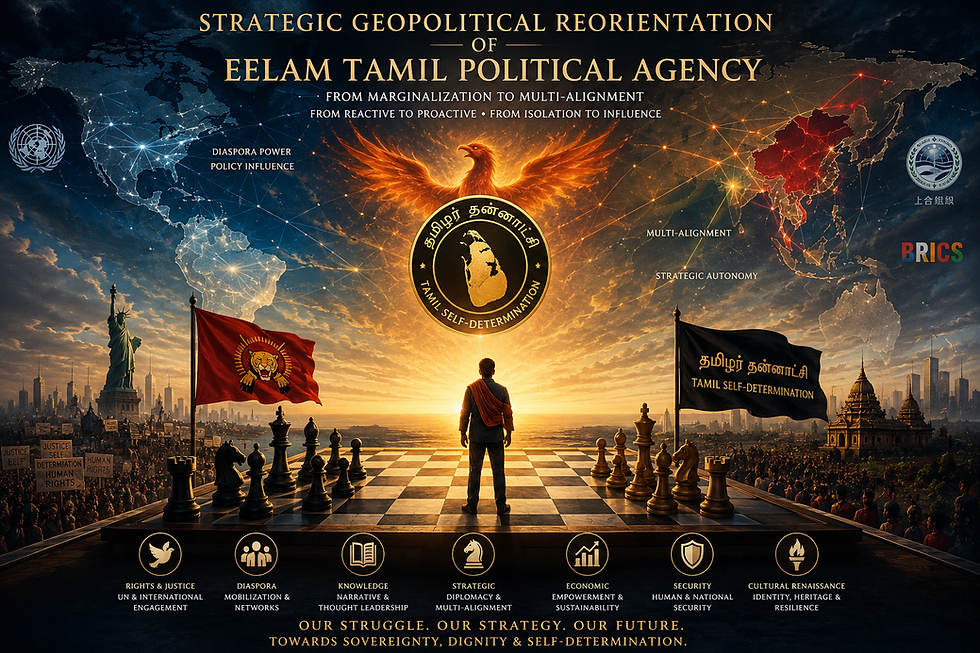
1. Temporal and Political Context
The dates 12/08/2024 and 13/08/2024 must be understood not merely as chronological references, but as politically significant moments that reflected an emerging transformation within contemporary Tamil Nadu political discourse. In many respects, these developments signalled a broader regional and geopolitical shift whose long-term implications may not yet be fully recognised within conventional political frameworks. Whether these developments were subsequently channelled into the appropriate institutional or strategic domains remains uncertain. Nevertheless, they represent an important historical inflection point that indicates the possibility of a renewed phase of political assertion for Eelam Tamils within changing regional and international conditions.
2. Structural Limitations of the Existing Political Paradigm
For decades, Eelam Tamil political engagement has remained heavily shaped by three dominant modes of political expression:
I) Emotional and reactive mobilisation
II) Commemorative politics centred primarily upon collective remembrance
III)Dependency-oriented advocacy seeking external sympathy without corresponding strategic leverage
Although these approaches emerged from conditions of war, displacement, structural violence, and political marginalisation, they are increasingly inadequate within the contemporary international system. Modern global politics operates through institutional influence, diplomatic negotiation, geopolitical relevance, and administrative sophistication rather than through emotion alone.
As a consequence, political legitimacy and long-term influence are no longer determined solely by moral claims or historical suffering, but by the capacity to strategically engage international institutions, state actors, diplomatic networks, and evolving geopolitical realities.
3. Necessity of Intellectual and Institutional Reorientation
A fundamental political transformation is therefore required. Eelam Tamil political thought must evolve from reactive political culture towards a disciplined, knowledge-based, and strategically organised framework capable of operating effectively within contemporary international structures.
Such a transformation requires:
I) A rigorous understanding of administrative systems and governance mechanisms
II) Advanced political literacy concerning international diplomacy and inter-state relations
III) Critical engagement with global human rights frameworks and international legal structures
IV) Institutional capacity-building capable of sustaining long-term political objectives
V) The development of geopolitical awareness grounded in realism rather than emotional expectation
This transition is not merely organisational; it is intellectual and epistemological. It requires replacing symbolic political expression with analytically informed political strategy.
4. Palk Strait Geopolitics as a Strategic Framework
A future-oriented Eelam Tamil political framework must be grounded within a Palk Strait–centred geopolitical perspective. The Palk Strait should not be viewed merely as a geographical boundary separating territories, but rather as a historically interconnected strategic space situated within the wider political and economic architecture of the Indian Ocean region.
Within this context, simplistic political narratives centred exclusively upon bridge construction, transport connectivity, or symbolic regional integration are strategically insufficient when detached from the broader structural questions of political autonomy, historical territoriality, and self-determination.
Accordingly, the central political objective should not be reduced to infrastructural integration alone, particularly when such approaches risk diluting the distinct political identity and historical sovereignty claims of the Eelam Tamil people.
Instead, political engagement should prioritise:
I)Long-term geopolitical positioning within the Indian Ocean region
II)Structured and institutionalised diplomatic engagement
III)Strategic participation within international political and legal forums
IV)Preservation and articulation of historical homeland claims
V) Advancement of self-determination principles through disciplined political mechanisms
Such an approach requires political maturity, strategic patience, and institutional continuity rather than episodic emotional mobilisation.
5. Transition from Reactive Politics to Strategic Political Agency
A fundamental transformation in Eelam Tamil political practice is now essential. Political engagement can no longer remain confined to emotional reactions, symbolic resistance, or fragmented advocacy lacking institutional direction. While such approaches emerged from historical trauma and prolonged structural oppression, they are insufficient within the contemporary international political order, where influence is increasingly determined through strategic negotiation, institutional capacity, and geopolitical relevance.
Accordingly, Eelam Tamil political engagement must transition towards a disciplined and outcome-oriented strategic framework grounded in long-term political objectives rather than short-term emotional mobilisation.
This transformation requires:
Replacing reactionary political responses with calculated diplomatic engagement
Moving beyond remembrance-centred politics towards policy-oriented institutional participation
Shifting from dependency-based advocacy to agency-driven political negotiation
Developing intellectual, administrative, and geopolitical competence capable of operating within international political structures
Converting historical memory into structured political leverage rather than symbolic expression alone
The objective is not the abandonment of historical consciousness or collective memory, but their strategic reorganisation into sustainable political capital capable of influencing regional and international political processes.
Ultimately, durable political advancement cannot be achieved through perpetual defensiveness alone. It requires the emergence of a politically sophisticated framework capable of negotiation, institutional influence, geopolitical adaptation, and long-term strategic continuity.
6.Normative and Strategic Conclusion
The contemporary political environment necessitates a comprehensive recalibration of Eelam Tamil political thought and practice. Historical experience, collective memory, and political suffering remain profoundly important; however, their continued relevance depends upon the ability to transform them into coherent strategic frameworks capable of functioning within contemporary international realities.
Any political structure grounded primarily in dependency, symbolic appeals, or perpetual supplication will inevitably encounter structural limitations in achieving sustainable political outcomes. Long-term political relevance instead requires autonomous strategic agency, institutional sophistication, geopolitical literacy, and disciplined engagement with evolving regional and global power structures.
The future of Eelam Tamil political advancement therefore depends not merely upon resistance, but upon the development of a mature strategic doctrine capable of integrating historical legitimacy with geopolitical realism, institutional competence, and long-term political vision.
Comments