
Transforming Bonded Labour Through Innovation, Governance, and Human Dignity:* Reflections from the House of Lords
- President Nila
- Jan 22
- 4 min read

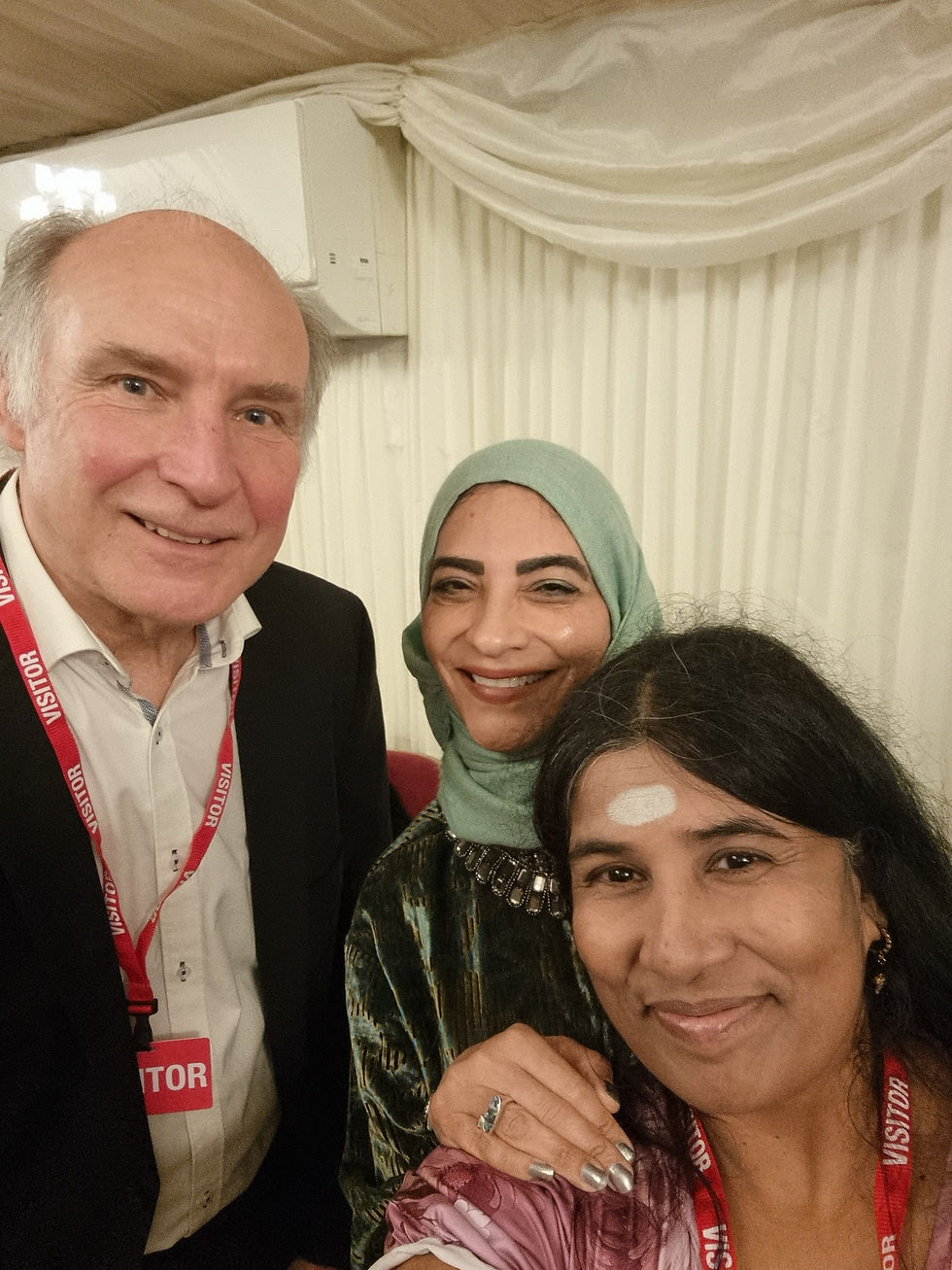
On 21 January 2026, I had the profound privilege of attending a high-level policy engagement at the Cholmondeley Room and Terrace, House of Lords, Palace of Westminster, London. Convened at 6:30 pm under the auspices of Baroness Gohir OBE on behalf of Families Set Free, the forum brought together an extraordinary assembly of intellectuals, scientists, social activists, and people-centred policy thinkers. My presence as an invitee—Balananthini Balasubramaniam—reflected the transnational reach and moral urgency of contemporary human-rights advocacy.
A striking feature of the event was the prominence of women leaders and professionals working across child protection, caregiving, public health, education, and community rehabilitation. The discourse was not merely descriptive; it articulated actionable strategies to dismantle bonded labour systems while foregrounding the welfare, education, and empowerment of women and children.
*Bonded Labour in Punjab: Deep-Rooted Structural and Cultural Challenges*
Bonded labour in Pakistan’s Punjab province is embedded within historical, socio-economic, and cultural structures. Children are often withdrawn from schools to sustain family survival, while women disproportionately bear economic and social burdens. This mirrors similar entrenched practices globally: in India, debt-bonded labour persists in agriculture and domestic sectors; in Brazil, children have historically been exploited in informal cocoa plantations; across sub-Saharan Africa, intergenerational labour obligations intersect with poverty, limiting educational access.
The Chief Minister of Punjab has demonstrated remarkable political commitment to confronting these systems. Her approach prioritises systemic reform over symbolic interventions, encompassing education, health, gender equity, and regulatory oversight—thus situating bonded labour as a matter of governance, human development, and national accountability.
From a capabilities perspective (Sen, 1999; Nussbaum, 2011), the intervention acknowledges that freedom and human potential are inseparable: children and women are not merely “rescued”; they are empowered to exercise choice, develop skills, and lead lives they have reason to value.

*Technological Innovation as a Liberation Mechanism*
At the core of this reform is locally manufactured technological innovation, introduced by Families Set Free to replace bonded human labour. These machines, produced entirely within Pakistan, ensure local economic engagement, skill transfer, and sustainability, while undermining the traditional economic rationale for exploitation.
The outcomes are transformative: tasks previously requiring 125 labourers can now be executed by five trained individuals in four hours, delivering 33% higher quality output than manual labour. Introduced in July of the previous year, this approach embodies what development theorists describe as the synergy of innovation and human dignity: efficiency is paired with emancipation.
Globally, similar interventions—such as mechanised alternatives in India’s textile industry or ethical cocoa processing in West Africa—underscore a growing recognition that technology can be a powerful enabler of liberation when coupled with social accountability and ethical governance.
*Governance, Surveillance, and Institutional Accountability*
The programme operates under full Government of Punjab oversight, embedded in a structured governance framework. Ministries—including Health, Education, Security, Public Relations, and Police Administration—coordinate across seven operational divisions, ensuring transparency, accountability, and systemic coherence. This model exemplifies the integration of state authority and civil society innovation, where NGOs act as visionaries, and governments ensure enforcement and scalability—a template with global applicability in anti-slavery policy.
*The Families Set Free Three-Stage Model*
Families Set Free operationalises its mission through a three-stage framework:
*Identification* of victims trapped in bonded labour systems
*Assessment and training*, tailored to individual and community contexts
*Facilitation of self-development enterprises*, enabling sustainable livelihoods
This model aligns with human development theory, recognising that liberation is a process, not an event. Bonded labour is entrenched across generations; meaningful reform requires cultural transformation, skill-building, and social re-education.
*Human Stories: The Transformative Power of Recognition*
President Michael W. Brickley shared a profoundly moving moment. He asked children emerging from bonded labour: “What is your future? Who would you like to become?”
The children did not immediately answer with words; instead, they smiled. That extraordinary smile, he observed, revealed that perhaps no one had ever posed such a question before. It was a quiet but powerful reassertion of human dignity and potential. Children, he emphasised, are inherently gifted; they require access to education and opportunity, not mere pity. Today, increasing numbers of these children attend school, embodying the true essence of Families Set Free: liberation as education, aspiration, and the right to dream.

*Women, Identity, and Resilience: Hayat Sindi’s Inspirational Address*
Equally compelling was Hayat Sindi, a biomedical scientist, inventor, and global health advocate. Drawing on her career at the intersection of science, innovation, and social responsibility, she spoke candidly about the systemic obstacles confronting women in STEM and society.
She emphasised that women often encounter negativity, resistance, and scrutiny, but these must never define their sense of self. Central to her address was identity affirmation: women must never dilute or conceal who they are to conform to external expectations. Authenticity, she argued, is a source of moral and intellectual strength. Her speech reframed resilience as ethical agency, inspiring all attendees to connect identity, empowerment, and societal transformation.
*Conclusion: A Global Template for Emancipation*
The House of Lords programme demonstrated that modern slavery can be confronted not only through rhetoric, but through technological disruption, ethical governance, and human-centred innovation. It integrated:
Empirical solutions (mechanised labour replacement)
Structural oversight (government ministries and accountability)
Ethical leadership (Brickley and Sindi)
Human development (child education, women’s empowerment, capabilities approach)
The Punjab model provides a replicable global template: entrenched systems of exploitation can be dismantled when governments take ownership, NGOs catalyse innovation, and interventions restore dignity, choice, and opportunity. Liberation, as this programme shows, is not merely the absence of bondage—it is the presence of possibility, identity, and hope.
Nila bala (Balananthini Balasubramaniam)
Small Drops CEO
Stop Human Trafficking CIC Ambassador & Coordinator
07:02
22/01/2026
United Kingdom


Comments